
Mango is economically important because it provides food, nutrition, employment, and income. It is also used in processing and various industries. Mango has significant domestic and export demand. Its by-products can also be utilized commercially. Therefore, mango is an important fruit crop from both agricultural and economic perspectives.
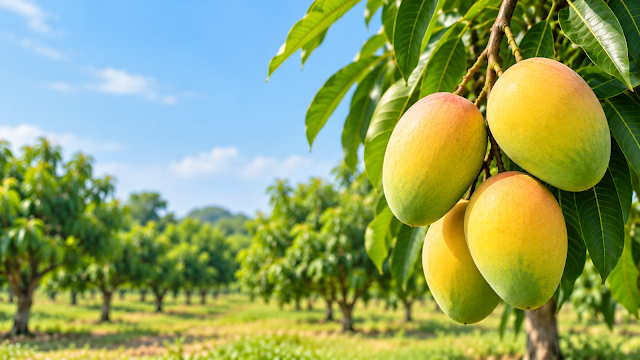
1. Fresh Fruit
Mango is an important fruit crop grown in tropical and subtropical regions.
It is widely consumed as a fresh fruit.
Mango has high demand in domestic markets.
Different varieties have different tastes, colors, and market values.
Premium varieties like Alphonso and Kesar fetch higher prices.
2. Nutritional Importance
Mango is a nutritious fruit rich in vitamins and minerals.
It is especially a good source of vitamin A and vitamin C.
It also contains carbohydrates and dietary fiber.
Mango provides energy and antioxidants to the body.
Therefore, it has high nutritional and food value.
3. Processing Industry
Mango is an important raw material for the fruit-processing industry.
It is processed into mango pulp and juice.
It is also used to prepare jam, jelly, squash, and nectar.
Raw mangoes are used for making pickle, chutney, and aamchur.
Processing helps increase the shelf life and value of mango.
4. Export Importance
Mango is an important fruit exported from India to international markets.
Indian mango varieties have good demand in foreign countries.
Alphonso, Kesar, and other varieties are important for export.
Mango exports generate foreign exchange for the country.
Export also provides better market opportunities for farmers.
5. Employment Generation
Mango cultivation creates employment opportunities in rural areas.
Workers are required for planting and orchard management.
Additional labor is required during harvesting and grading.
Packaging, transportation, and processing also generate employment.
Thus, mango cultivation supports many people directly and indirectly.
6. Farmer Income
Mango is an important source of income for fruit growers.
A well-managed mango orchard can remain productive for many years.
Farmers can earn income from fresh fruits and processed products.
Premium varieties can provide higher returns in the market.
Therefore, mango cultivation can contribute significantly to farm income.
7. Industrial Uses
Different parts of the mango fruit have industrial importance.
Mango pulp is widely used in beverages and processed foods.
Mango seed kernels can be used for extraction of mango kernel fat.
Mango peel can be used for producing certain value-added products.
Thus, mango provides raw materials for several industries.
8. Medicinal Importance
Mango has traditional medicinal importance in several cultures.
Different parts such as leaves, bark, flowers, and fruits have traditional uses.
The fruit contains antioxidants and several nutrients.
Mango leaves and other plant parts are used in traditional remedies.
However, medicinal use should be based on appropriate scientific and medical guidance.
9. Value Addition
Mango is highly perishable after harvesting.
Processing can convert fresh mango into products with a longer shelf life.
Products such as pulp, juice, pickle, and dried mango have added value.
Value addition can help reduce post-harvest losses.
It can also increase income opportunities for farmers and processors.
10. By-products
Mango processing generates useful by-products such as peel and seed.
Mango seed contains a kernel that has commercial value.
Kernel can be processed to obtain mango kernel fat.
Mango peel can be explored for pectin and other value-added products.
Utilization of by-products helps reduce waste and improve overall profitability.